Rachel Watson
The Girl on the TrainRachel Watson is a commuter, a heavy drinker, and an unreliable witness to the events surrounding Megan Hipwell’s disappearance. Her importance lies in the collision between what she sees and what she can remember: she pursues the case while doubting her own perceptions, until recovered memories expose Tom Watson’s role and lead her to confront him.
Identity and Background
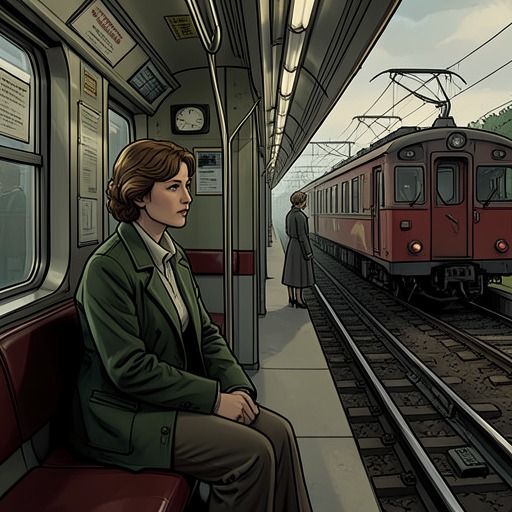
On the 8.04 train from Ashbury to Euston, Rachel notices a pile of clothing beside the tracks: light-blue fabric mixed with something dirty white. She considers ordinary explanations, including rubbish or workmen’s discarded clothes, but the scraps prompt her to imagine the absent person who might have worn them. Her mother and Tom Watson have both described her imagination as overactive, a judgment that hangs over her later attempts to distinguish observation from invention. The delayed, slow-moving train is part of her routine, carrying her through a landscape she watches closely but cannot always interpret reliably.
Rachel’s drinking is a central condition of her life and of the plot. She experiences gaps in memory after drinking and wakes with injuries whose causes she cannot establish. Bruises on her arms seem particularly troubling to her, but she can only speculate about how they happened. She imagines that she might have gone to Tom and Anna Watson’s home and attacked Anna, yet this is a frightening possibility she constructs in the absence of memory, not a confirmed account of an event. That uncertainty leaves Rachel vulnerable to both her own suspicions and other people’s judgments of her.
Drinking, Memory, and Suspicion
After Tom leaves Rachel a message, she learns that he has spent nearly an hour looking for her and that Anna was frightened enough to consider calling the police. He tells Rachel to stay away from his family. She does not know what she has done to provoke this response or where she was during the missing hours. The message turns her memory loss into a source of immediate fear: she cannot dismiss the possibility that she has harmed someone, but neither can she confirm the imagined scene that fills the gap.
When police officers visit her home, Detective Inspector Gaskill asks about her actions on Saturday evening. Rachel is already afraid that she may somehow be involved in Megan’s disappearance, and the officers’ questions make that fear concrete. Later, she approaches Scott Hipwell because she believes the police did not take her account seriously. She does not tell him that she has already identified the man she saw with Megan to the police; instead, she lies about what she has disclosed, hoping to preserve Scott’s trust and continue asking questions. Her investigation therefore begins not with authority or certainty, but with a compromised effort to be believed.
Investigating Megan’s Disappearance
Rachel’s credibility becomes an obstacle. After Detective Sergeant Riley speaks to Scott following his release, Scott confronts Rachel with what he has been told: the witness who alleged an affair was considered unreliable, alcoholic, and possibly mentally unstable. Rachel insists that she had not been drinking when she witnessed the couple in the morning, but the fact that she was sober at that moment does not erase the larger problem of her drinking or her memory gaps. Scott’s response makes clear that the police’s assessment has reached him and weakened the trust on which Rachel’s private inquiry depended.
Even so, Scott continues to ask Rachel what she remembers. He presses her to think about the night Megan died and asks whether she saw a car associated with Tom. Rachel cannot give him a usable answer. Her memories arrive as disjointed possibilities: an argument, a fall on the station steps, a man helping her, the underpass, voices, and blood. She is unsure which fragments belong to reality and which to a dream. Scott tells her that Megan’s death was believed to have occurred that night or soon afterward, and that the cause was head trauma. Rachel is therefore asked to supply a crucial memory at precisely the point where her own mind offers only uncertainty.
Recovering the Night at Witney
Rachel’s recollections return through specific places and encounters rather than through a complete, orderly account. At the entrance to the underpass in Witney, seeing a woman in a deep-blue coat recalls Anna in a blue dress with a black belt. Rachel remembers Anna walking quickly, looking back, and then getting into a red car that she recognizes as Tom’s. The memory contradicts what Rachel understood from the police: that Tom had come looking for her alone while Anna remained at home. The contradiction intensifies her frustration, but it also gives her a concrete detail to test against the fragments in her mind.
A fellow passenger from the night in question supplies another piece. He remembers talking with Rachel on the train, helping her after she slipped on the station steps, and later finding her upset near the underpass. Rachel had a cut and appeared to have been in a quarrel with her partner. The man recalls that Tom drove away with someone, though he does not identify that person. His account supports parts of Rachel’s recollection without resolving every question, preserving the distinction between what another witness confirms and what Rachel herself remembers.
Relationships and Conflict
Tom’s rejection and Rachel’s attachment to the life they once shared remain entangled. She watches the house on Blenheim Road and notices that its front door has changed from dark green to black; she wonders what else has been altered, including the kitchen and the room for Anna’s baby. These observations show how closely Rachel attends to a home that is no longer hers, while her questions about its interior register the persistence of her connection to Tom and her displacement by Anna’s family life.
Rachel also encounters warnings from the police about her approach to Scott. She has been told to stay out of the investigation, and Detective Sergeant Riley criticizes her for lying to Scott, telling him she was his wife’s friend, and provoking a man under considerable strain. Riley warns that Scott may be dangerous and that Rachel’s interference could jeopardize the investigation. Rachel rejects the suggestion that her involvement is harmless, but her willingness to continue despite the warning places her in escalating conflict with both the police and Scott.
Change and Narrative Role
Rachel’s recollections eventually alter her understanding of her own past. She had treated the memory of Tom striking her in the underpass as unreal, a frightening image from a half-dream. She comes to recognize it as something that happened, and also remembers that she was not the person swinging a golf club in another disturbing episode. These discoveries do not restore every missing hour, but they undermine the explanations Tom has given her and reveal how thoroughly uncertainty has shaped her account of their relationship.
In the final confrontation shown here, Rachel uses Tom’s belief that she may be responsible for Megan’s death to draw close enough to accuse him of killing Megan. She then fights back and briefly gets away, taking the keys as she leaves the house. Tom catches her before she can reach the fence, and the struggle continues toward the tracks. The passage ends with Rachel trapped at the bottom of the garden, facing Tom as a train approaches. Her arc has shifted from imagining herself as a possible culprit to naming Tom as Megan’s killer and acting against him, but the scene leaves the immediate outcome unresolved. As narrator and investigator, Rachel makes the novel’s uncertainty structural: the reader receives clues through a mind that is at once perceptive, damaged by alcohol, and unable to trust its own chronology.